
By Bradley Hastings
When organisations attempt change, they typically lean on the achievers – those who have shown themselves to deliver outcomes and success. This instinct appears to make sense. But question is whether the mindset that wins in the current game is the best for reimagining it?
We’ve all been there. The executive team books an away day to stand back, take stock and reimagine a better future. Discussions are deep, perspectives are debated. The whiteboard fills with a bunch of initiatives, new ideas and stretched targets to match, and everyone leaves feeling productive and energised.
But two weeks later the impact has faded. A few initiatives have lost their relevance, and others have hit roadblocks. Moreover, the stretched targets produce something paradoxical: implementing the new ideas will take time, and time is becoming scarce – so the organisation defaults to running faster, and the new ideas begin to play second fiddle.
This pattern plays out time and time again. It’s not a question of lack of effort, or the wrong people – it’s the mindset that has been applied to diagnose, and fix, the problem.
The achiever mindset
“Every thought can be scrutinised directly except the thought by which we scrutinise.” – E. F. Schumacher
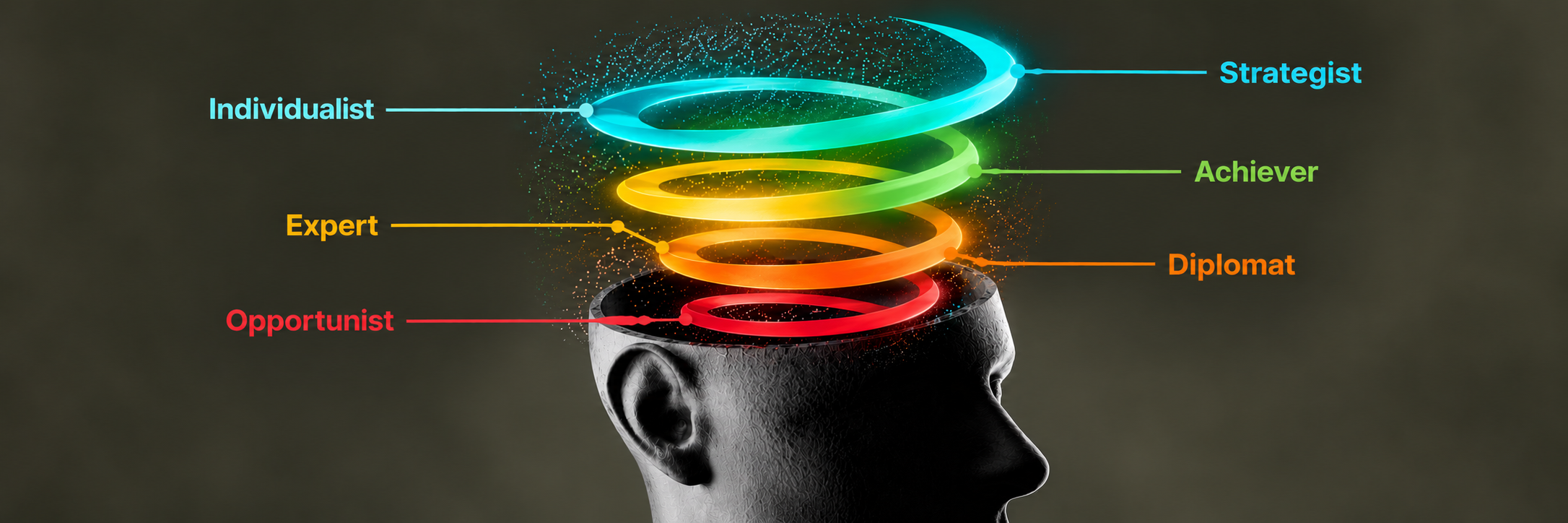
What the team brought to this challenge is the achiever mindset. It has real benefits and real drawbacks. Overall, there is nothing wrong with it. It is the engine of business and the engine of capitalism. It is also one of the most common mindsets in leadership: in the research behind Rooke and Torbert’s 2005 Harvard Business Review article, about 30% of leaders profiled at achiever and only 4% at strategist, the group most able to lead an organisation through transformative change.
The cues of an achiever are subtle but clear. The relentless focus on results. The family holiday with an itinerary a project controls team would admire. The leader who takes up meditation and, within a month, is hosting morning mindfulness sessions. Or that person who just can’t stop talking about their accomplishments.
What achievers get right
Achievers make things happen. They start with the outcome in mind and build a plan to get there. They differ from experts, who prefer to give advice. An achiever is the person who builds the plan, corrals the effort and, if necessary, shape-shifts around challenges to get to the goals.
Major projects run on this mindset. When a schedule slips six months, the achiever is the person who has a completed recovery plan by Friday, and a back-up one by Monday in case the first fails. Every project board wants this person, and is right to have them in the team.
The dark side of achievement
The trouble starts when organisations want to imagine something different. The achiever mindset works like gravity – a steady pull back to a world organised around accomplishment: houses, mortgages, holidays, the kids’ school, the Instagram update to confirm the holiday took place.
Go back to the away day. It asked everyone to stand back and take stock. But what played out wasn’t exactly what was hoped for. The people brought together to imagine the new strategy were the very same ones trying to achieve the previous version. The flaw is that the new strategy was framed through the lens of the old one, and what remained overlooked was the possibility to reframe the game. Their achiever mindset was already framed by success factors of the previous year – what worked and what didn’t. The new strategy stretched this a little – it called for a bit more of what worked and a bit less of what didn’t.
While achiever is the engine of progress, it is short-sighted about new ways of being. Doing and being sit in tension, and the tension for an achiever is reliably settled in favour of doing. The questions left unasked are the strategist’s questions. Who should we be? Why are we here? What purpose do we serve? What should we stop doing? What are the systemic issues that are impeding progress?
Where the achiever turns wicked
Asking achievers to be strategists has three wicked traps.
The first is capacity. The people selected for leading change are the ones keeping the system running. Free them up and results dip; keep them on the wheel and the thinking never happens. Most organisations choose the wheel and schedule the thinking for an annual away day.
The second is reward. People reach senior roles by achieving. For strategic thinking, they are asked for something their bosses have never paid them for – to stop, pause, doubt the goal, and to sit with questions that have no deliverable.
The third is the most stubborn: every strategy challenge can be decoded into a set of steps to achieve. Tell an achiever to be more strategic and they will set it as a goal, build a plan and report progress. These are the people for whom “Reflect more” turns up in the performance review, yet they are entrusted with strategic thinking because they are seen as the best people to deliver it.
Put the above three together and you have the paradox of change – organisations attempt change, lean on the top performers, engage the mindset that built the system, and change falters. It is what happened after the away day: the new ideas needed time, and the stretched targets took it. We run faster, without getting anywhere at all.
Where to from here?
Strategists are the ones that step back and reframe the game. They look for the pattern behind the problems, decode patterns, reframe thinking, and work on the system that keeps producing them.
There are many strategy frameworks that aim to develop strategic thinking. But the problem is not lack of knowledge, it’s more that an achiever handed a strategy framework will complete it, on time, with every box filled – and miss the point entirely.
Developing a strategist is a bit like teaching someone to delegate. It is a common topic in executive education, yet remains the most often-named leadership struggle. Teaching rests on a delegation framework. But what we find holds leaders back is something more fundamental – an unspoken worry that delegation will reduce quality, or a deeper need to be seen as capable themselves.
Kegan and Lahey call these competing commitments. The leader sincerely wants to delegate, and is equally committed, out of sight, to something delegation threatens. The developmental work needs to happen here, at this identity level. Commonly taught frameworks are limited to technique, without changing the leader.
Mindset development
Developing from achiever to strategist takes the same approach as learning to delegate. It is an identity shift. Achievers are achievers because they are validated by their achievement. No amount of stepping back will counter the internal validation achievers get for as long as achieving is who they are.
The work, then, is helping leaders hold achievement as a component of their repertoire – a mindset they can pick up and put down when they choose. It starts with awareness, then it’s a bit like building a muscle – it takes time, a challenge their current way of working cannot solve, and people around them willing to ask an uncomfortable question and wait for the answer. It is slower than a framework and impossible to fit on a slide.
This is the work we do at the John Grill Institute for Project Leadership. What comes out the other side is a leader who can run fast, and who can also stop, look up, and ask whether this is the right game to play.
Sources
- Rooke, D. and Torbert, W. (2005), “Seven Transformations of Leadership”, Harvard Business Review. Percentages taken from a summary of the article.
- Kegan, R. and Lahey, L. (2009), Immunity to Change, Harvard Business Press.
- Schumacher, E. F. (1977), A Guide for the Perplexed. Wording checked against The Marginalian’s quotation of the passage.